
Dr. Fabio Sasahara
Introduction to Managed Lanes
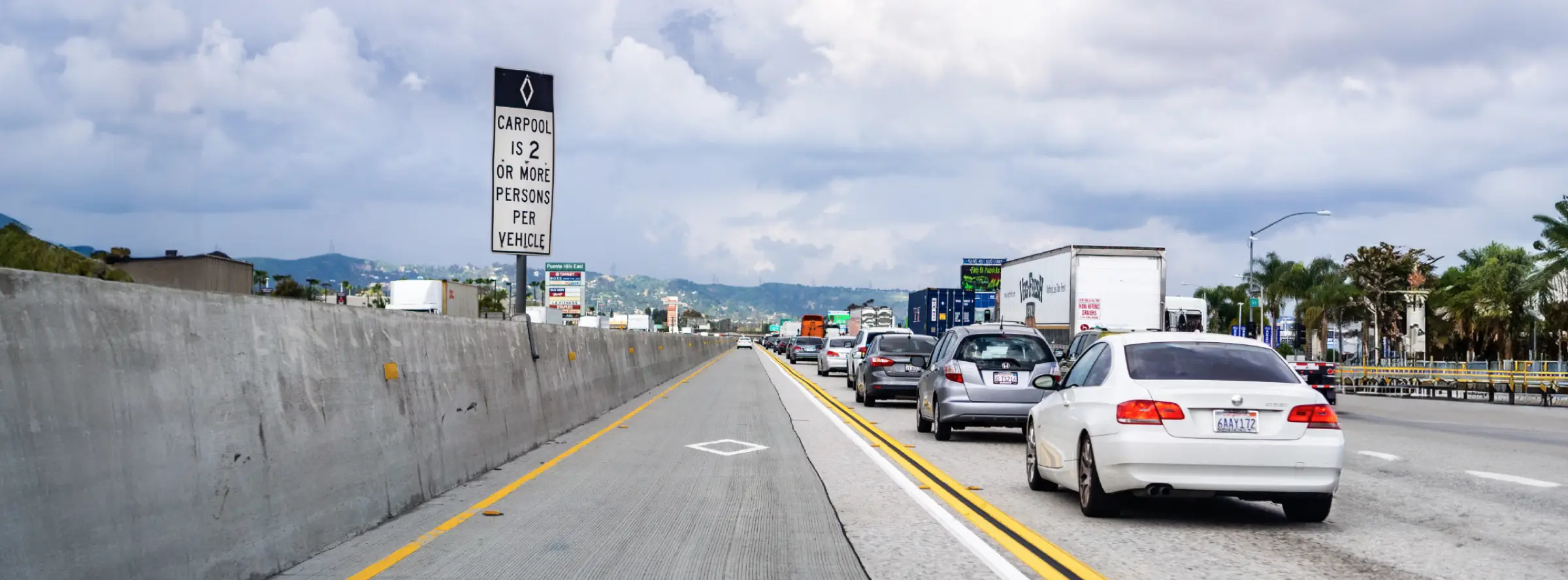
Managed lanes (MLs) are freeway lanes where operational strategies are applied to actively control demand and maintain reliable traffic performance, particularly during congested periods. In practice, MLs are implemented to provide improved travel conditions compared to adjacent general purpose (GP) lanes, often maintaining higher speeds and more stable levels of service. The term “managed lanes” is a broad umbrella that encompasses several facility types, including Express Lanes, High-Occupancy Vehicle (HOV) lanes, High-Occupancy Toll (HOT) lanes, and other pricing- or eligibility-based strategies.
To start modeling Managed Lanes in a Freeway Facility (HCS), check the box “Managed Lane” under the General page:
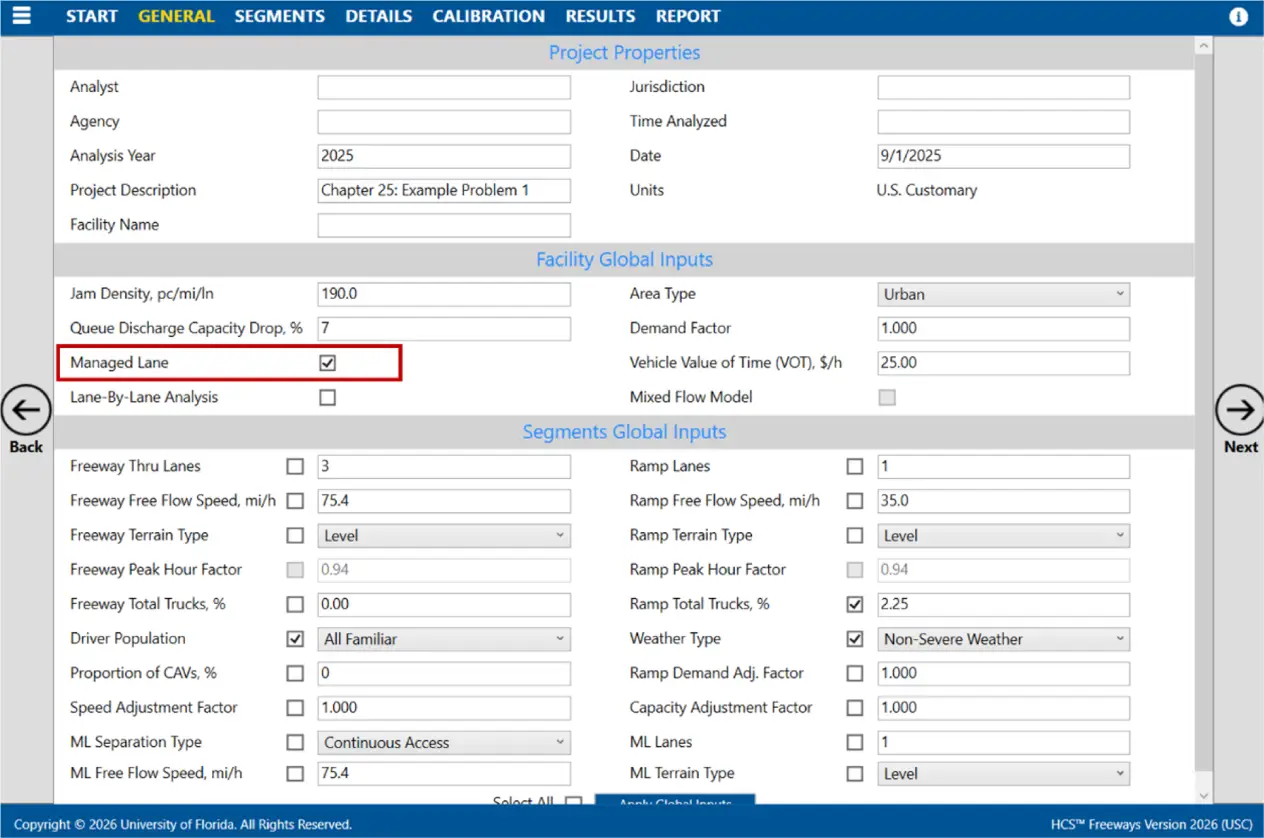
Setting up ML Analysis in a Freeway Facility
Defining ML Segment Types
After managed lanes are added to the facility, the next step is to model the ML Segment Types:
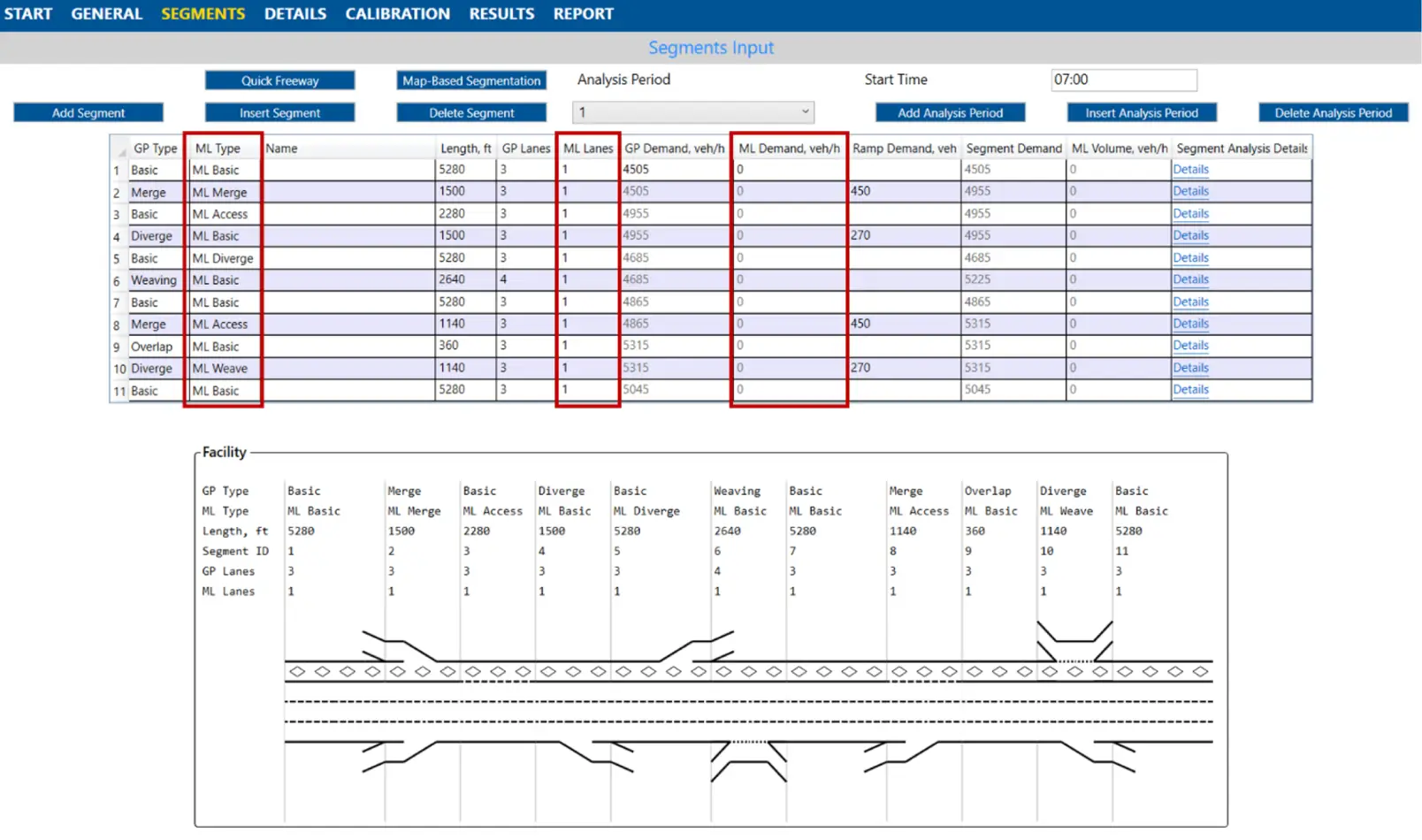
Setting up ML Segment Types in HCS
- ML Basic: This is analogous to the general basic freeway segment, but serves ML traffic.
- ML Merge and ML Diverge: These are analogous to GP Merge and Diverge segments, but with ML traffic demands.
- ML Weaving: This is analogous to the GP Weaving segment, but with ML traffic demands.
- ML Access Segment: This segment type is unique to ML facilities with intermittent access. Lane changing between the GP lane group and the ML group can occur throughout the segment.
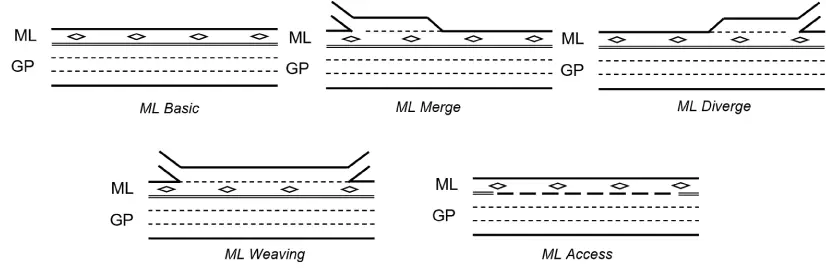
Different ML Segment Types
Capacity Models for Managed Lanes
The capacity of managed lanes in the HCM framework is primarily determined by Free-Flow Speed (FFS) and the type of separation between ML and GP lanes.
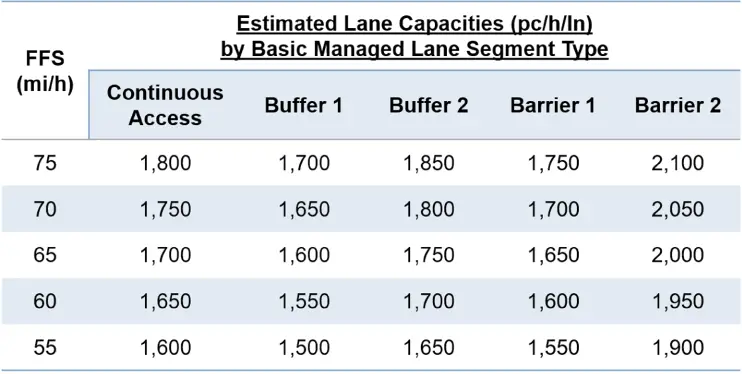
Estimated ML capacities as function of FFS and separation
Separation treatments, such as a single solid line, a striped buffer, or a physical barrier—affect driver behavior and lane-changing opportunities, which in turn influence achievable capacity. In general, more restrictive separation treatments reduce the friction from lane changes and yield higher lane capacities.
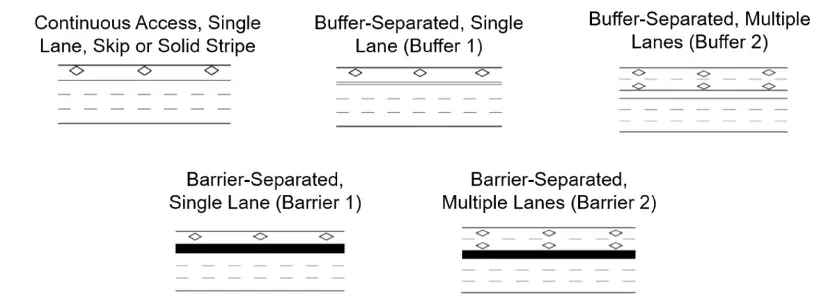
ML-GP Separation types
Detailed Inputs – Managed Lanes
In HCS, all inputs that are typically defined for GP lanes—such as demand, heavy vehicle percentage, and adjustment factors—must also be entered separately for ML to reflect their distinct operating characteristics. If modeling ML Merge/Diverge/Weaving segments, the inputs required will be equivalent to the ones required for GP Merge/Diverge/Weaving:
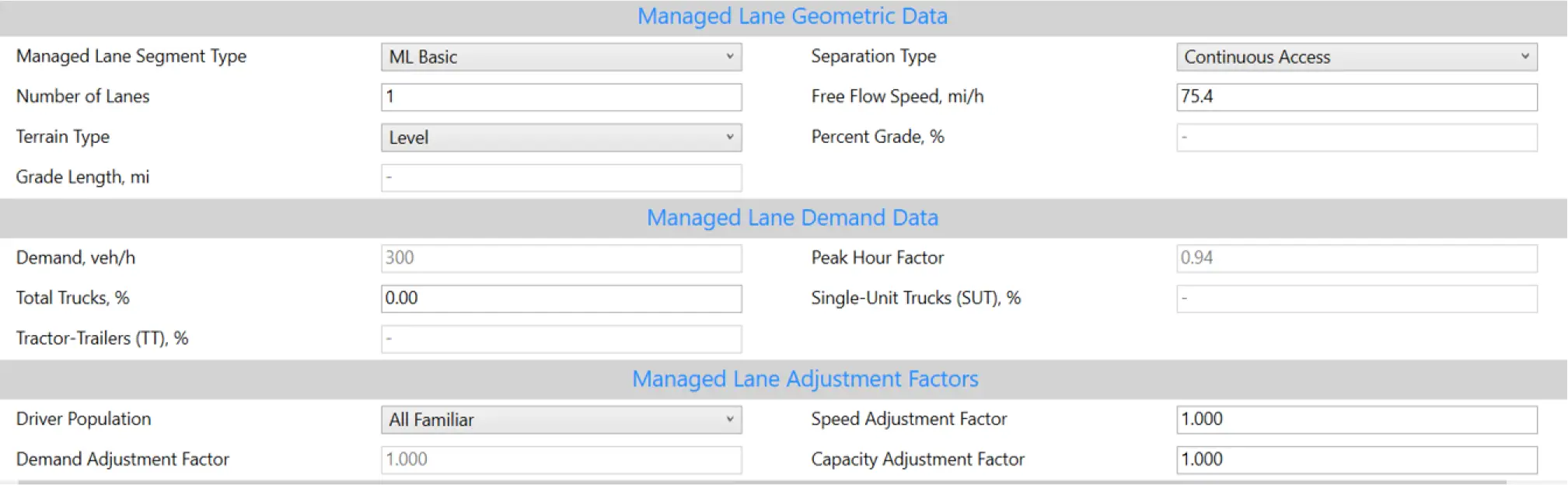
Detailed ML Inputs in HCS
Interactions Between Managed Lanes and GP Lanes
In the HCM methodology, managed lanes are generally treated as operating independently from GP lanes for the cases previously discussed. The only segment type that accounts for interactions between ML and GP lanes is the ML Access.
These access points are modeled in HCS as special cases of weaving segments, where vehicles must cross GP lanes to enter or exit the ML. As part of this process, analysts are required to input both GP-to-ML and ML-to-GP demand volumes to represent directional traffic movements.
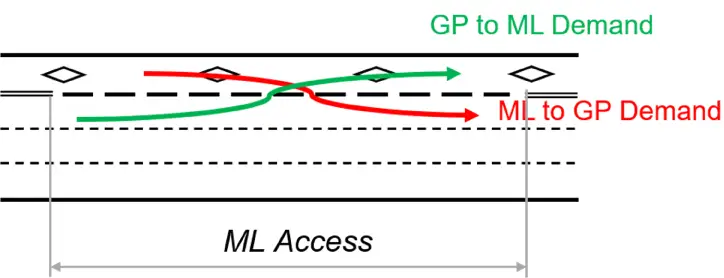
ML Access Point with bidirectional flows between GP and ML
For locations with directional access—such as entrance-only or exit-only configurations—only the relevant directional volume should be specified.
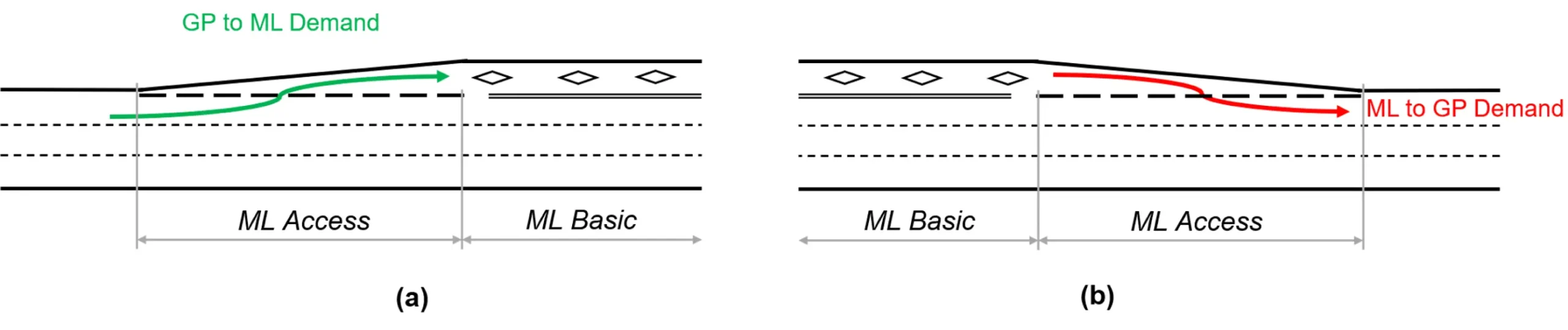
ML Access Point with directional flows between GP and ML: (a) entrance-only and (b) exit-only