
Dr. Fabio Sasahara
Climbing lanes are an important feature on two-lane highways because they help maintain traffic flow and improve safety. When heavy trucks or other slow-moving vehicles travel uphill, their speed often drops significantly, creating long queues of faster vehicles behind them. A climbing lane provides an additional lane that allows slower vehicles to move aside, enabling other drivers to pass safely without entering the opposing traffic lane.
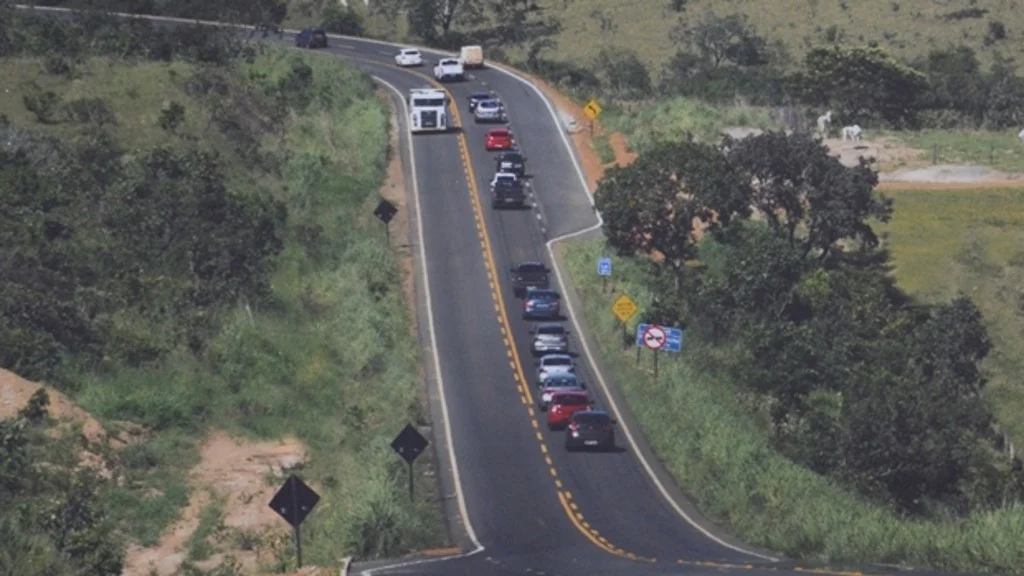
Climbing lane on an uphill segment (Source: AGETOP-BR)
By reducing vehicle platoons and minimizing risky passing maneuvers, climbing lanes improve travel efficiency, decrease driver frustration, and lower the likelihood of head-on and rear-end collisions. They are particularly beneficial on steep grades where speed differences between vehicles become more pronounced. Overall, climbing lanes enhance both the capacity and safety of two-lane highways while providing a smoother driving experience for all road users.
This article outlines steps to assess the need for climbing lanes on the Highway Capacity Software (HCS), based on guidelines from the Highway Capacity Manual and the AASHTO Green Book.
Green Book Warrants
The AASHTO Green Book 7th Edition (2018), Section 3.4.3, says a climbing lane on a two-lane highway should be considered when all of the following are met:
- Upgrade traffic flow exceeds 200 vehicles per hour (veh/h)
- Heavy-vehicle volume (trucks, buses and recreational vehicles) exceeds 20 veh/h during the design hour
- And one of the following exists:
- A typical heavy truck is expected to lose 10 mph (15 km/h) or more;
- Level of service (LOS) on the upgrade is E or F
- LOS drops by two or more levels from the approach segment to the grade
HCM Chapter 15 Procedure
When analyzing two-lane highways, the Highway Capacity Software automatically checks for the Green Book criteria previously discussed. Most required parameters are straightforward and are either user inputs or common performance measures. For the specific condition “A typical heavy truck is expected to lose 10 mph (15 km/h) or more”, the Highway Capacity Manual (HCM) Chapter 15, Two-Lane Highways (Appendix A) provides a procedure to estimate truck speed reductions on upgrades. Three different truck types can be modeled in this procedure: single-unit, intermediate semitrailer, and interstate semitrailer.
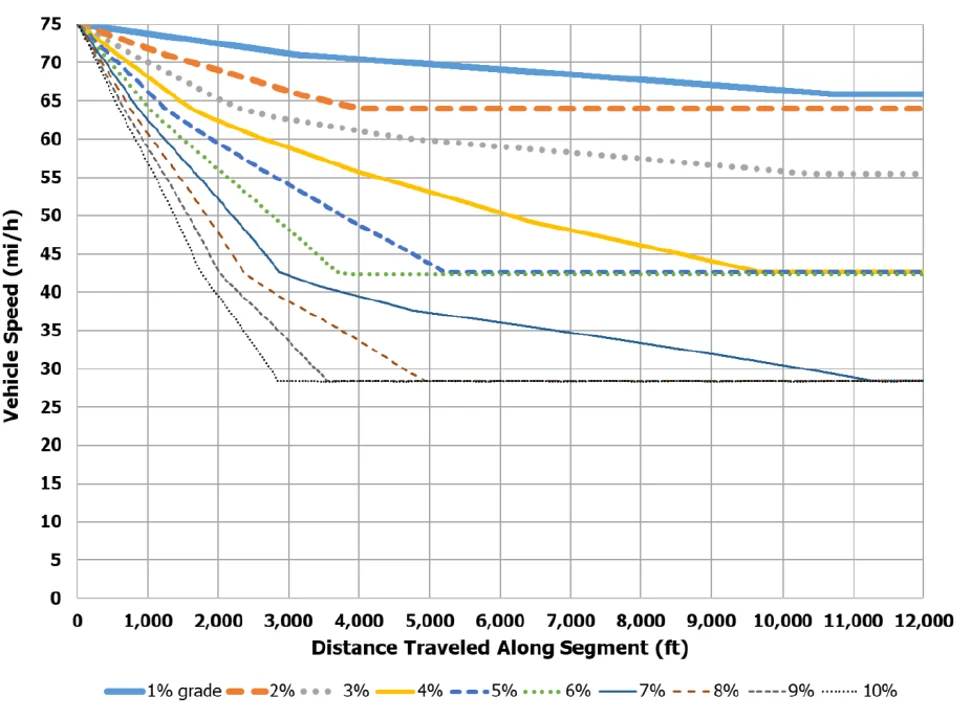
Upgrade Speed–Distance Curves for Single-Unit Trucks (Source: Highway Capacity Manual)
Modeling in HCS
Start a new Two-Lane Highway analysis using the Highways module. Provide all required inputs as usual, as no additional inputs are required for this analysis. These conditions are automatically checked internally in HCS, and the detailed results can be accessed at the bottom of the Text Report:
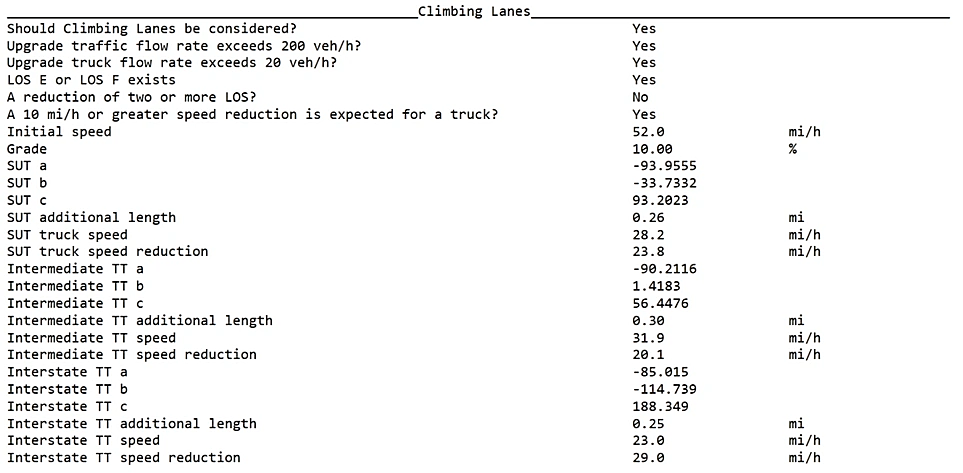
If enough conditions are met to justify the installation of climbing lanes, a warning message will be provided in HCS: