
Dr. Fabio Sasahara
The 2026 update of the Highway Safety Software introduces new crash prediction methods to assess crashes involving pedestrians and bicycles, which are anticipated to be included in the upcoming Highway Safety Manual 2nd Edition.
This article provides an overview of methodological aspects and their implementation in the Highway Safety Software 2026 release.
Background
While the first edition of the HSM (2010) was a major step forward for quantitative safety analysis, its methods for pedestrians and bicyclists were often limited, and restricted to Urban/Suburban facilities only.
Additionally, for segment analyses, ped/bike crashes were estimated as a simple proportion of motor vehicle crashes, an approach that is not sensitive to site-specific conditions that influence non-motorist safety, such as the presence of sidewalks, traffic calming measures, crossing treatments and bicycle lanes.
The methods recently implemented in HSS 2026 address this gap by providing a state-of-the-art methodology that allows you to evaluate the safety impacts of specific design and operational choices for pedestrians and bicyclists.
For a complete technical overview of the methodology, please refer to Section 4 of the NCHRP Research Report 1064.
Intersection Analysis
The pedestrian crash model analyzes each intersection leg separately, which are then added together to produce the predicted crash frequency. The bicycle crash model analyzes the major and minor streets, which are then added together.
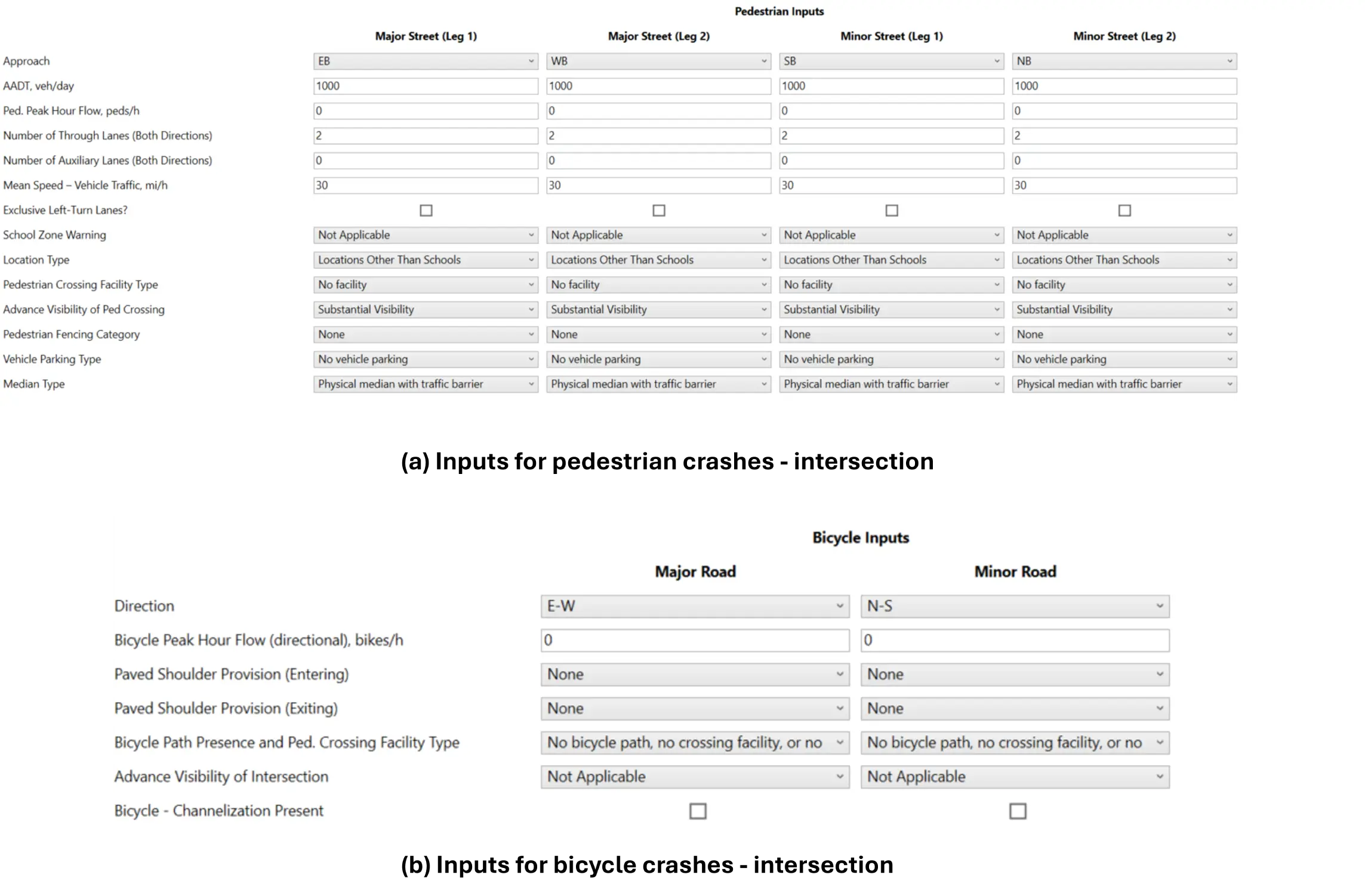
Inputs for (a) pedestrian and (b) bicycle crashes at intersections in HSS
Factors involved in the crash prediction methods include:
- Facility type
- Vehicular AADT
- Peak hour volume, for bicycles and pedestrians
- Number of crossing lanes
- Mean vehicular speed
- Crossing treatments
- On-street parking
- Median type
- Exclusive left turn lanes
Segment Analysis
The model separately estimates crashes related to movements along the road (left and right sides), as well as mid-block crossings (analyzed similarly to an intersection leg). These three separate components are added together to produce the predicted number of crashes for a segment.
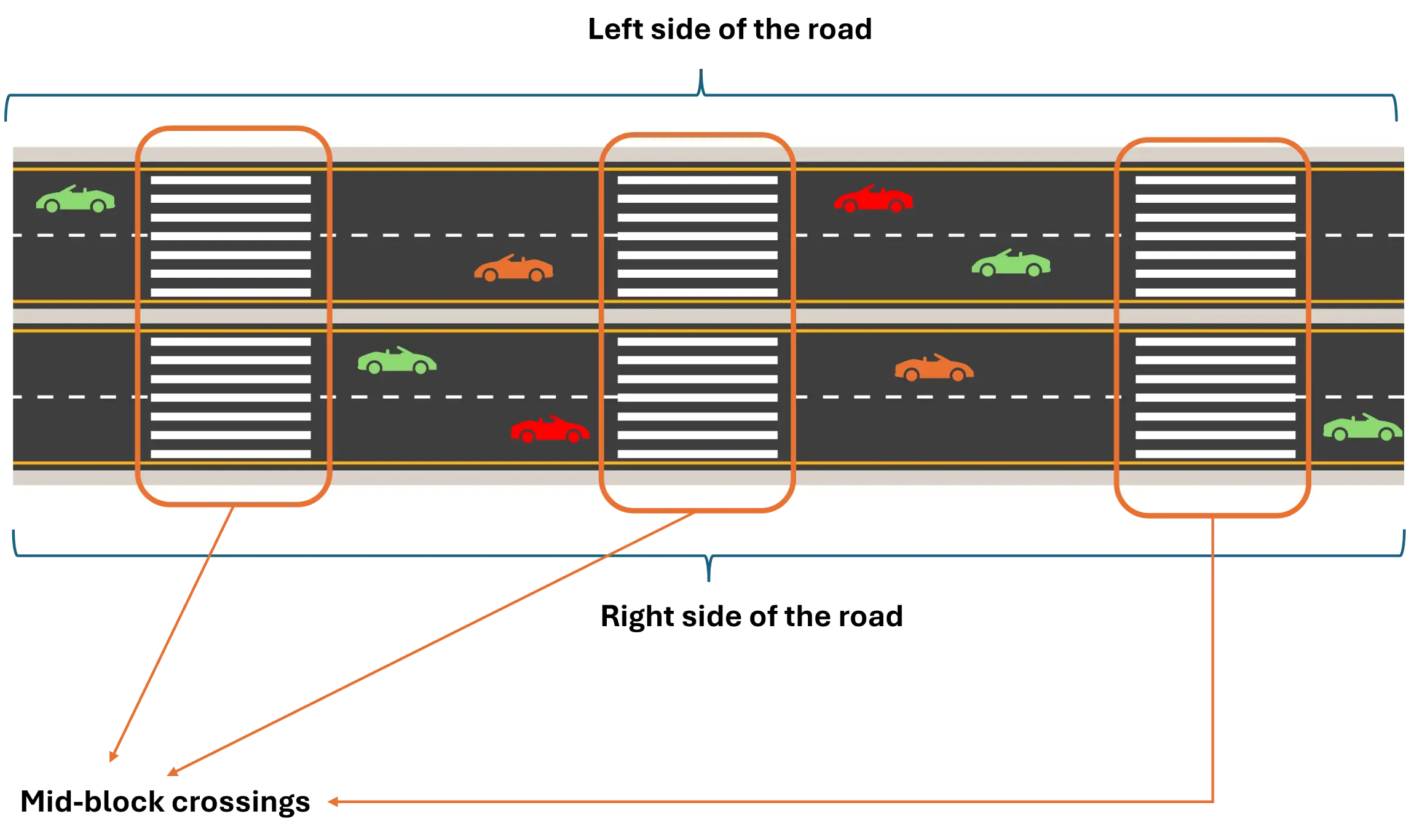
Components evaluated for pedestrian and bicycle crashes at segments
Factors involved in the crash prediction methods include:
- Facility type
- Vehicular AADT
- Peak hour volume, for bicycles and pedestrians
- Sidewalk and shoulder provision
- Lane width
- Horizontal curvature
- Mean vehicular speed
- On-street parking
HSS Implementation
The new pedestrian and bicycle crash methods are available for segments and intersections in the following facility types:
- Rural Two-Lane Highways
- Rural Multilane Highways
- Urban and Suburban Arterials
The new pedestrian and bicycle analyses can be enabled by checking the box under the “General” page, as shown below:

Enabling the new Pedestrian and Bicycle Methods in HSS
If analyzing Urban and Suburban Arterials, the pedestrian and bicycle crashes computed through the new method replace the corresponding calculations based on HSM1 methods. For Rural Highways, pedestrian and bicycle crashes are only reported separately from vehicular crashes since they are not present in HSM1 methods.

Summary of crashes per mode in Urban / Suburban Arterials - HSS
Detailed reports are provided for pedestrian and bicycle crashes. The new methods also yield a breakdown by crash severity, based on all degrees of the KABCO scale – the severity proportions can also be calibrated in the software if needed. Additionally, the new method also yields the number of persons injured per crash, which can also be calibrated in the software.
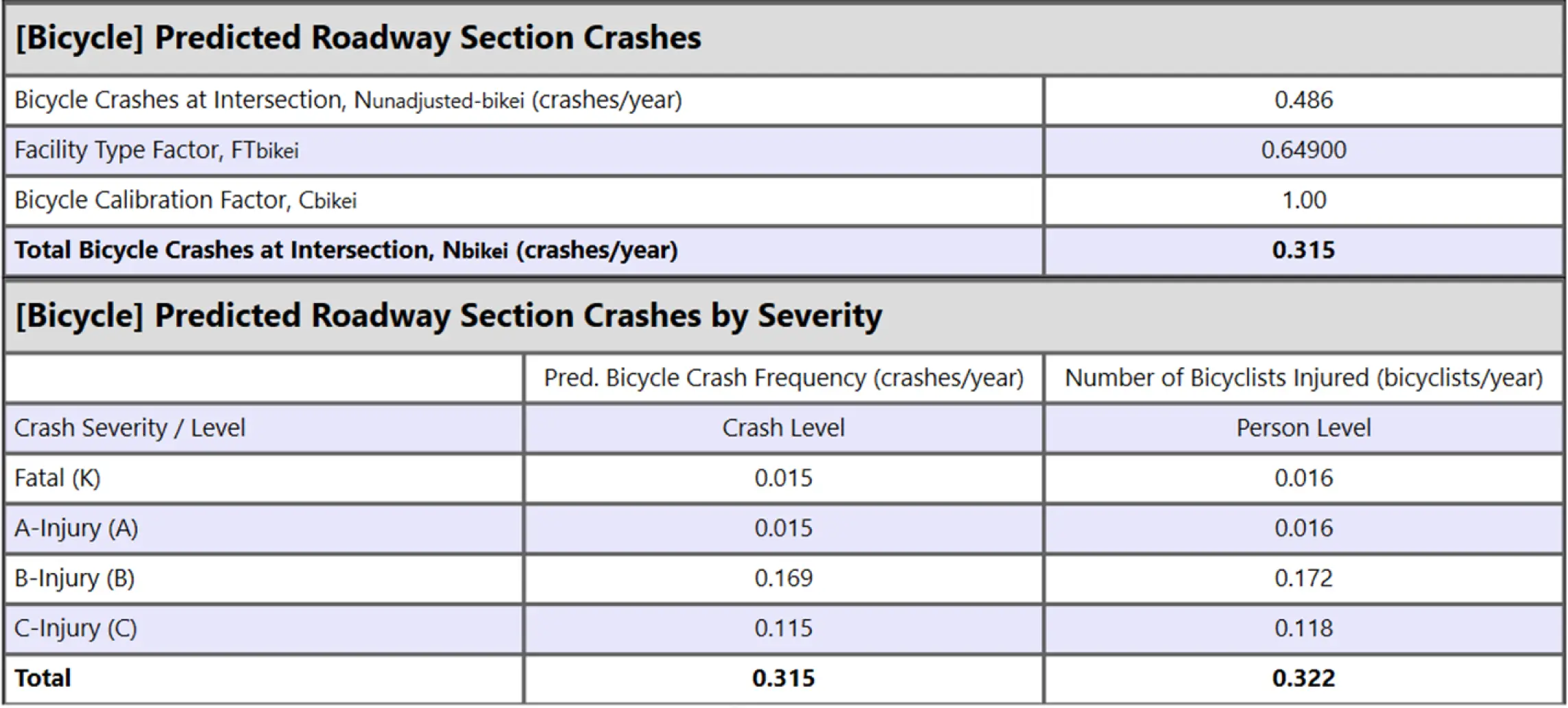
Output - Bicycle Crashes in HSS