
Dr. Fabio Sasahara
The Highway Capacity Manual (HCM) allows segment level evaluation and a facility level evaluation of Freeways, with different chapters discussing specific methods.
When several segments are linked together in a corridor, interactions such as queue spillback, shockwave propagation, and capacity-reducing bottlenecks become possible, and the methodology must account for these spatial and temporal effects. As the analyses become significantly more complex, so do some of the outputs listed in HCS reports.
The 2026 update of the Highway Capacity Software redesigned freeway reports to further help users understand the implications of congested conditions and facilitate the critical analysis of the model results. This article provides an overview of the main principles and definitions associated with congested conditions, as well as their representation in HCS outputs.
Principles and Definitions
Volume and Demand are two terms that are often used interchangeably in the HCM, but they have different definitions in the Freeway Facilities context.
- Demand (d) – the amount of traffic that wishes to travel through the segment. It is a user input in HCS.
- Volume served (v) – the actual flow that can be accommodated, and never exceeds the segment’s capacity. It is internally computed, and can be limited by capacity constraints.
If no oversaturated conditions (demand > capacity) exist in the freeway facility, demand and volume served are equal. However, during oversaturated conditions, the volume served is aggregated through a series of complex equations that compute flows on the freeway every 15 seconds.
Illustrative Example
A simple freeway with a merge bottleneck is modeled in HCS as shown below:
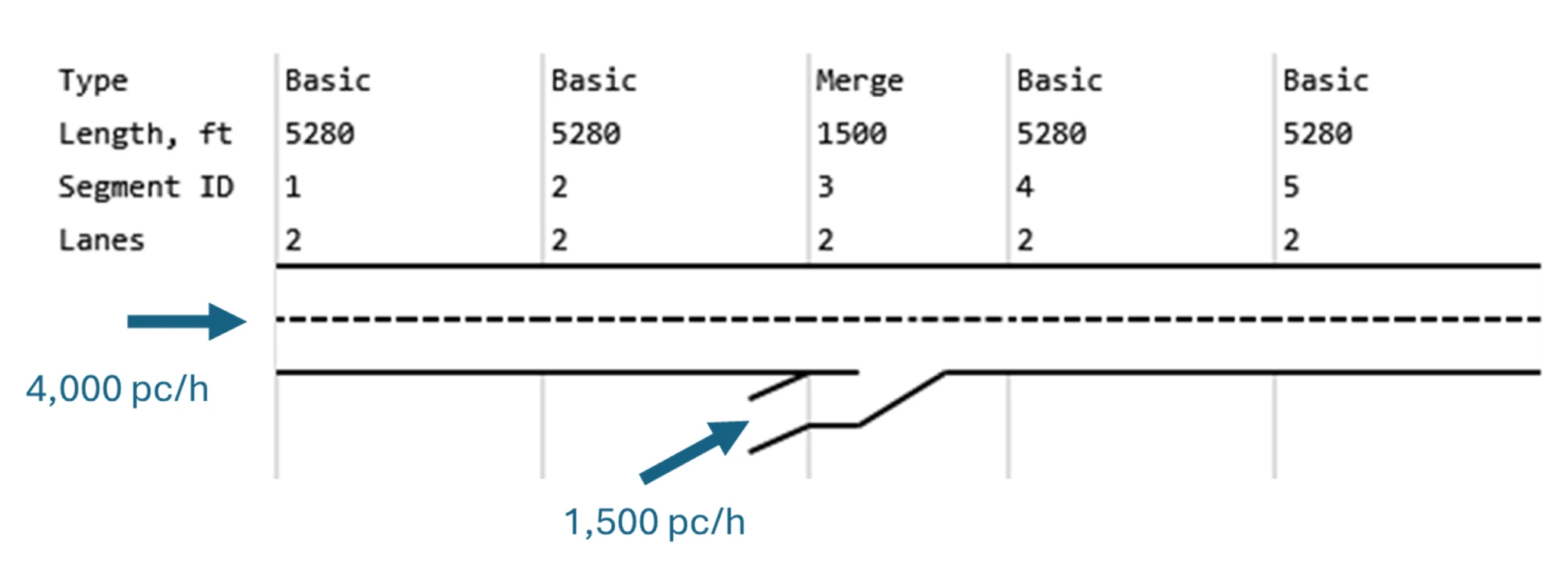
As shown in the table below, segment 3 (Merge) becomes a bottleneck (d/c >1) , where the combined demand from the freeway and on-ramp exceeds the segment capacity.
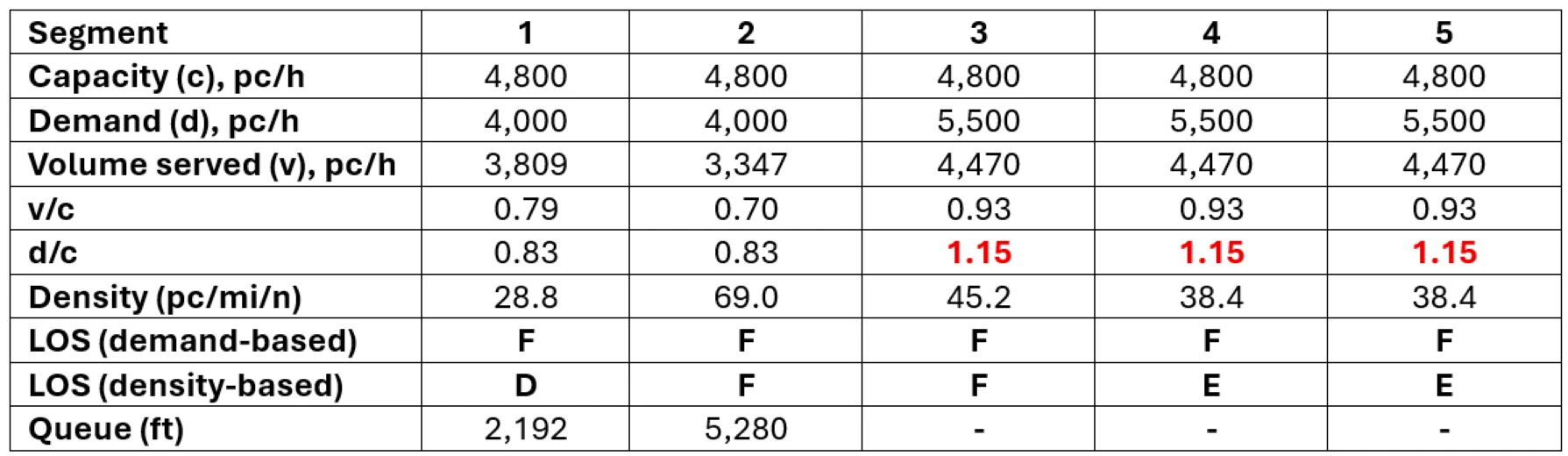
Table showing variables by segment
As shown in the table, the presence of a bottleneck results in the volume served differing from demand, not only at the bottleneck but also at adjacent segments. At downstream segments 4 and 5, the arriving flow is constrained by the throughput in segment 3. At upstream segments 1 and 2, the throughput is limited by the presence of a queue developing upstream of the bottleneck.
By understanding and comparing the differences between demand and volume served, the analyst can extract valuable insights from the analysis to support their study reports.
Changes in HCS report
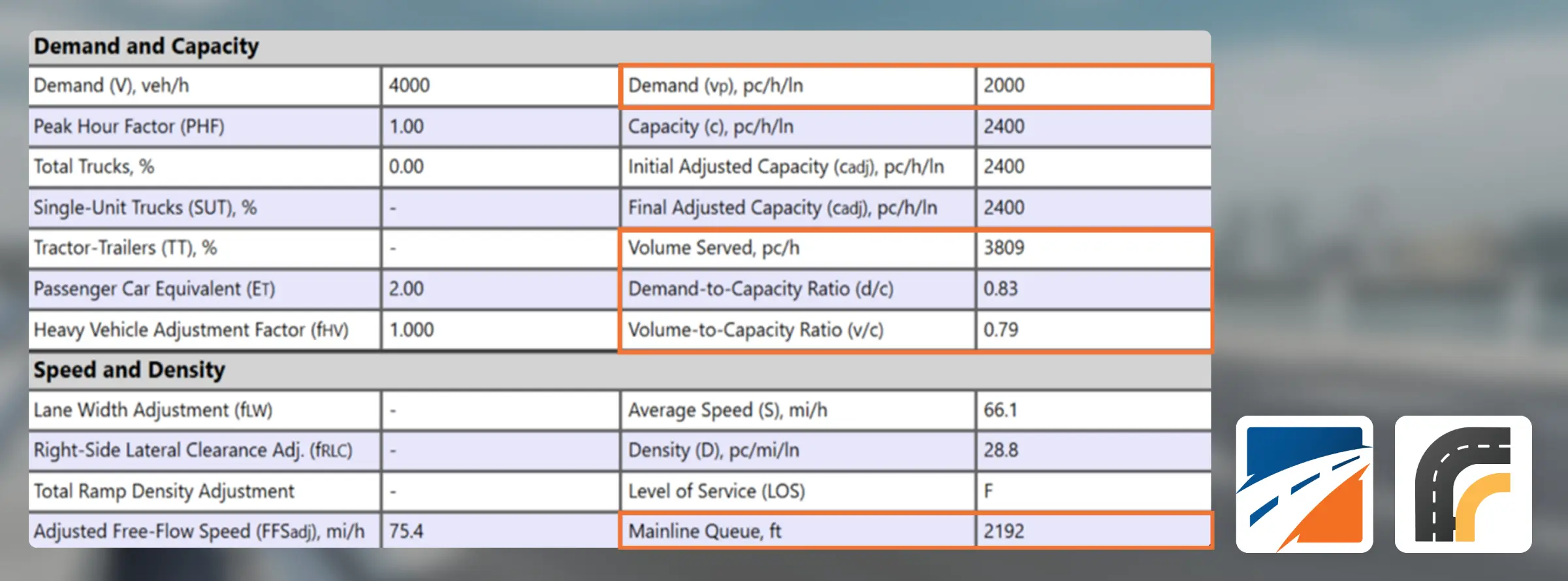
Every segment report now includes both “Demand” and “Volume Served”, allowing them to be compared side by side. Additional outputs added to the report include Mainline Queue Length and On-Ramp Queue (whenever applicable).
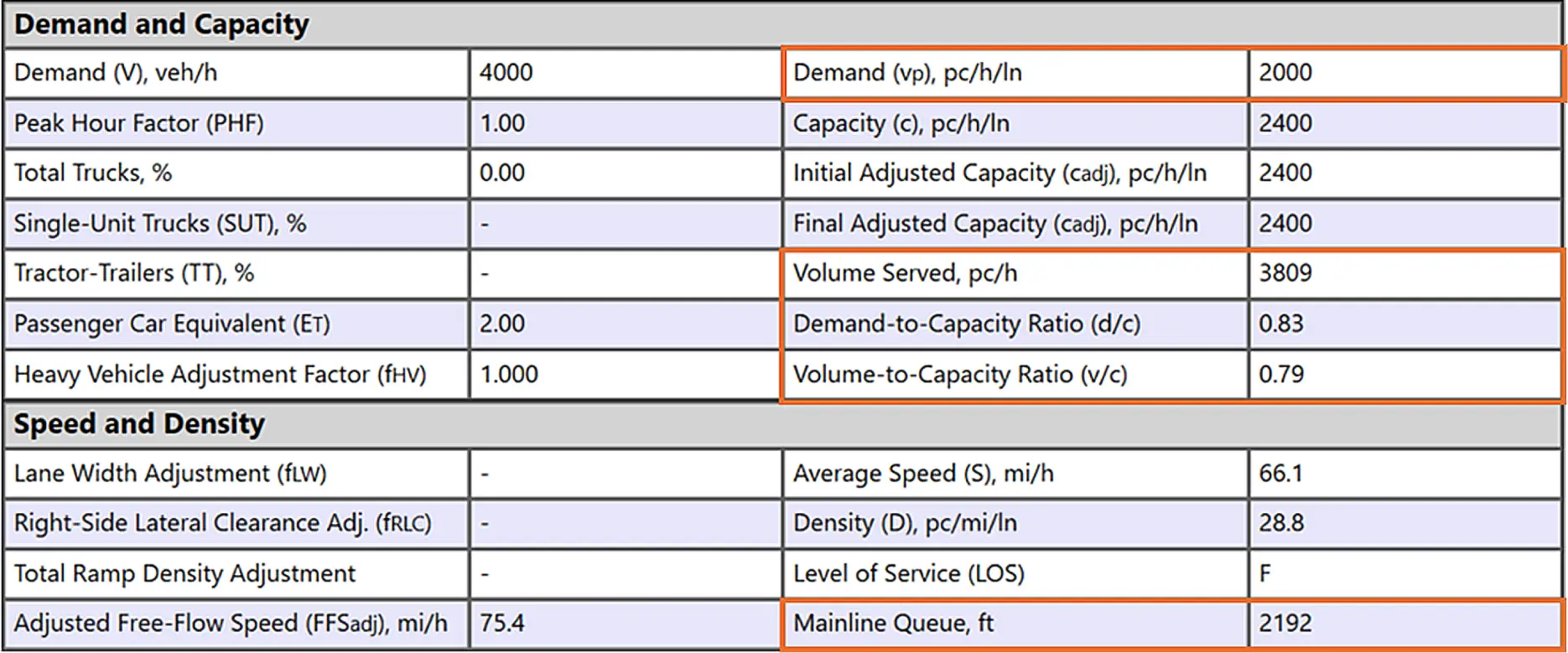
Sample report (HCS 2026) – Segment 1 (Basic)
I have a bottleneck with demand exceeding capacity, but why is my volume-to-capacity ratio 0.93?
When a bottleneck occurs, the queue discharge rate is slightly lower than the pre-breakdown capacity, estimated around 7% by research. This capacity drop can be changed in HCS under the “General” page. Therefore, when bottleneck occurs, the computed volume served will be 93% of the segment capacity for a default value of 7% for the queue discharge capacity drop.

Defining the Queue Discharge Capacity Drop value in HCS
Why are ramp queues reported for merge segments, but not for diverge?
When a merge segment operates in oversaturated conditions, the number of vehicles able to enter the freeway through the on-ramp is limited. The HCM method for oversaturated conditions includes equations that compute the flow rate that can enter the segment during a specific analysis period. Any demand beyond that amount will form an on-ramp queue, reported at the end of the merge segment analysis.
It is worth noting that on-ramp queues do not affect freeway operations in the HCM context, as the merge ramp roadway is not part of the methodological scope of analysis for freeways. However, those queues can impact the upstream ramp terminals, creating additional congestion.

On-Ramp Queue output in a Merge segment
Off-ramp queues are a more serious operational problem, from the freeway operations perspective. Queue spillback from the off-ramp into the freeway can create severe congestion on the freeway, which cannot be accurately modeled by traditional HCM Freeway methods. Therefore, queues caused by a congested ramp roadway in a diverge segment are not reported as part of freeway analyses in HCS. It is possible, however, to use the HCS Network module to evaluate the presence of queue spillback in a freeway off-ramp due to a congested ramp terminal.