
Dr. Fabio Sasahara
The TWSC methodology is a complex procedure that evaluates the interactions of multiple movements with different priorities in an intersection. In certain cases where an oversaturated movement affects others, a known HCM limitation prevents the methodology from correctly computing some performance measures. This article discusses the details of this TWSC method limitation, and how it is addressed in HCS.
Overview of Gap Acceptance Principles
The HCM TWSC methodology is based on gap acceptance theory, where lower-priority movements must find acceptable gaps in one or more higher-priority traffic streams before proceeding into the intersection.
In the TWSC method, capacity and delay for each movement depend on:
- The availability of gaps, determined by the volume of conflicting traffic streams.
- How drivers use the gaps in traffic streams, determined by driver behavior parameters, such as critical headway and follow-up headway.
The TWSC method classifies movements into four ranks, with different priorities:
- Rank 1 (full priority, does not yield to others): major street through and right, pedestrians crossing the minor street
- Rank 2 (yields to Rank 1): major street left/u-turn; minor street right, pedestrians crossing the major street
- Rank 3 (yields to Ranks 1-2): minor street through (4-leg intersection) or minor street left (3-leg intersection)
- Rank 4 (yields to Ranks 1-3): minor street left (4-leg intersection)
The Issue
As previously discussed, drivers must find gaps in higher-priority traffic streams to enter the intersection. However, there may be cases where these higher-priority movements are operating over capacity, leaving no available gaps for lower-priority movements to use. In theory, that would lead to zero capacity and infinite queues at these lower-priority movements.
Looking more closely at the methods, the capacity of a given movement is also influenced by the “Probability of queue-free state” of its conflicting movements. A conflicting movement with a low probability of a queue-free state reduces the number of available gaps, leading to a loss of capacity for lower-priority movements.
The figure below illustrates a conflict between movements at minor street approaches. Drivers performing an EBL movement (a priority rank 4) must yield to the WBT stream (a priority rank 3).
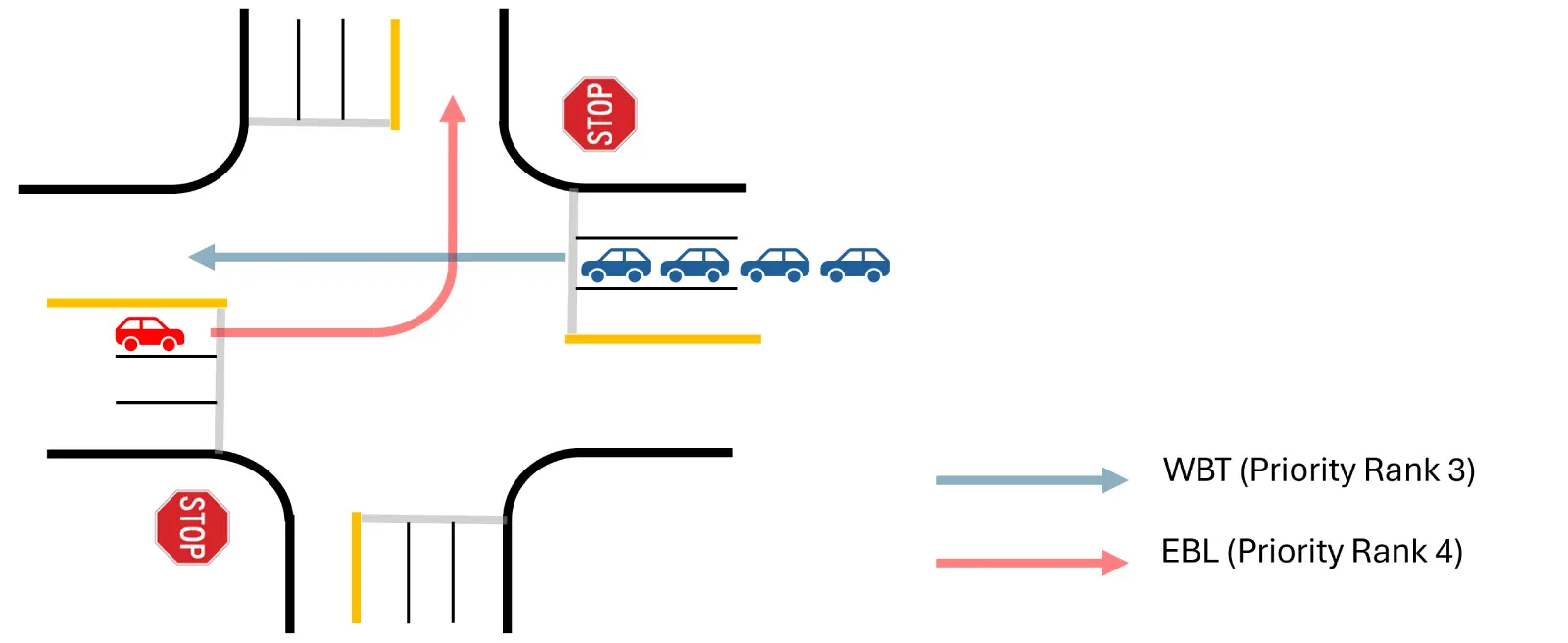
EBL driver yields to oversaturated WBT traffic
However, if the WBT movement operates above capacity (see figure below), it will have zero probability of being in a queue-free state. In theory, EBL drivers would never be able to find a feasible gap, and therefore the capacity of the EBL movement would be zero.
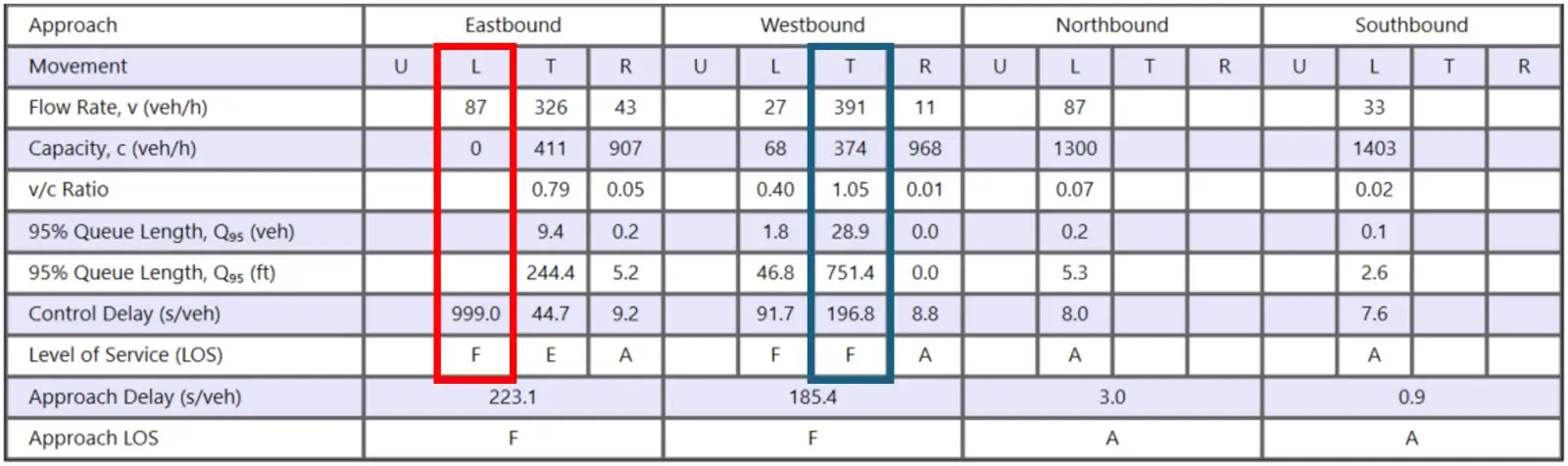
When this HCM limitation is hit, HCS automatically reports a LOS F and assigns a delay of 999 s/veh:

Although it is reasonable to conclude that these affected movements are likely to operate at LOS F, caution is advised when interpreting the results, since these conditions are not well addressed by HCM models. Research found that when unsignalized intersections operate in congested conditions, traditional gap acceptance models do not yield realistic results. Additionally, research findings suggest that during such congested conditions, drivers may take a more cooperative approach, with higher-rank drivers yielding to lower-rank drivers.